Anti-Black panic and mob violence in Chicago
Native SonAnti-Black panic and mob violence in Chicago is the citywide reaction to the discovery of Mary Dalton’s remains and the search for Bigger Thomas. Newspapers frame the case as a sexual crime by a Black man against a white woman, and that framing helps turn the pursuit of one suspect into a threat against Black residents as a group. The panic is not only a surge of public fear: it licenses mass searches, vigilante participation, attacks, and economic reprisals, while the investigation reveals the segregated arrangements already shaping Black life.
News and the Making of a Threat
The crisis accelerates when reporters find bones in the furnace at the Dalton home. The newspaper announces the discovery as a breakthrough in Mary Dalton’s presumed kidnapping, then reports that authorities suspect Bigger Thomas killed her and burned her body. Although the report presents a sex crime as a possibility, its language gives that allegation enormous force. Bigger reads the account while in hiding and understands that the public label has already made him appear deserving of death before his capture. The distinction between a reported suspicion and established fact blurs as the story travels through the city.
The press also casts the case as a possible Communist conspiracy, notes that Jan Erlone has been held, and reports that investigators have not found his fingerprints in the Dalton home. It nonetheless preserves suspicion that Jan may have been an accomplice, claiming that the plan seemed too elaborate to have been devised by a Black man alone. Bigger recognizes that this story both distorts the facts and directs attention toward a wider political threat. He considers going to the police to clear Jan, but the public narrative around the case has already made confession perilous.
Search and Collective Punishment
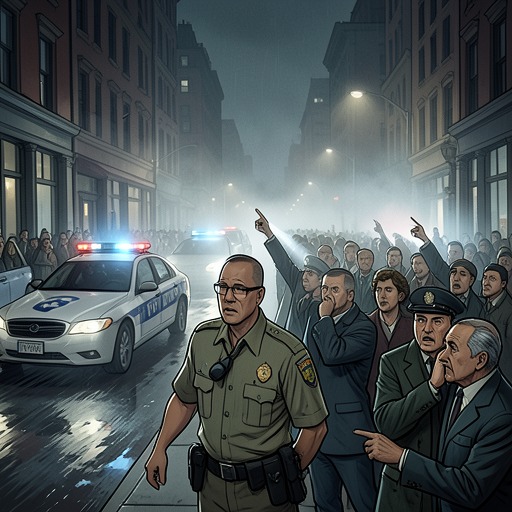
The authorities’ response rapidly expands beyond an ordinary search for a suspect. A cordon of five thousand police, joined by more than three thousand volunteers, is reported around the Black Belt; streetcars, buses, trains, and cars leaving the South Side are stopped and searched. Police and vigilantes search Black homes under a blanket warrant, while several hundred Black men resembling Bigger Thomas are detained for investigation. The report also describes smashed windows in Black neighborhoods, men beaten elsewhere in the city, and white vigilante groups offering assistance that the police chief says will be accepted. White parents ask school officials to close schools until the suspect is caught; the account records their request, not that the schools close.
A later report enlarges the scale again: eight thousand armed men search cellars, abandoned buildings, and more than a thousand Black homes. Its map marks the searched territory closing in from the north and south until only a small white square remains in the Black Belt. For Bigger, the map turns the city’s pursuit into a narrowing geography of entrapment. Yet its significance extends beyond his hiding place: the same boundaries that organize the manhunt make the Black neighborhood itself appear as the object of suspicion and search.
Fallout in Black Communities
The panic reaches Black residents who have no connection to the case. In a conversation reported from the community, one man blames Bigger for making white people think Black people are all like him; another counters that white people already treat every Black man as guilty and that the violence is falling on the community indiscriminately. Their disagreement is sharpened by immediate material consequences. A laborer says his employer has laid him off, claiming that white public anger makes it unsafe for him to work in the streets. He resents the lost wages and says he would inform on Bigger if he knew where to find him, even as his companion warns that complying with white demands will not protect Black people from collective punishment.
The argument shows panic working in two directions at once. It pressures Black residents to distance themselves from Bigger and prove their respectability, while the searches, assaults, and dismissals make clear that individual innocence offers little security. The public response treats a Black suspect as evidence against Black people generally; the resulting economic and physical harm is borne by people who are neither accused of nor involved in the crime.
Segregation Behind the Emergency
The investigation’s public drama rests on conditions that precede the search. At the inquest, questions to Mr. Dalton establish that his company’s rent policy helps keep Black families in one area; when asked why Black tenants pay more for comparable housing, he disclaims responsibility for setting the rates. The exchange links the crisis to a system of housing discrimination rather than to personal prejudice alone. The Black Belt is not simply where the police look for Bigger: it is a bounded residential space produced and maintained through unequal terms of housing.
Max’s argument at trial likewise asks the court to look beyond an isolated criminal act to the social order that shapes people’s lives. He rejects the idea that explaining Bigger’s circumstances means claiming that Bigger is an innocent victim or asking the court to excuse him. Instead, he describes a life constrained in where a person may live, how much schooling he can obtain, and what work he can do. He points to the contradiction of education that awakens ambitions while the world beyond the school door denies the means to pursue them. His case is that social conditions must be confronted if the city is not to repeat the same pattern of fear, hatred, and crime.
Unequal Attention and an Enduring Threat
The inquest makes the racial hierarchy of public concern especially visible when Bessie Mears’s body is presented. Bigger had been so consumed by fear of the consequences of Mary Dalton’s death that he had forgotten Bessie during the proceedings. Her death, previously unmentioned in the inquest, is brought forward as evidence against him, and Bigger understands that it may intensify demands to destroy him rather than prompt comparable concern for a Black woman who was killed. The episode exposes a double injustice: Bessie’s suffering is marginalized in public attention and her body is made to serve a case centered on the white victim.
The threat continues into the trial. A newspaper reports that the governor has ordered two regiments of the Illinois National Guard to protect public order amid fears of mob violence, rising demands for the death penalty, and anxiety about an uprising in a Black neighborhood. The troops signal that authorities recognize the danger of collective violence; their deployment does not erase the atmosphere that produced it. Across the search, the inquest, and the trial, the novel presents panic as a process: racialized reporting enlarges suspicion, public and official action makes that suspicion materially coercive, and segregated institutions leave Black residents exposed to its consequences.